Tuesday, June 18, 2013
DRM aims to Rewrite eBooks to catch Pirates
God forbid we would hope to see new technologies facilitate the way for content to reach more people than ever. Today we see parties worrying about locking down digital content in a way that it gets even more restrictive than previous forms, like books and its newer eBook digital format. While you could once do whatever you wanted with an actual book, with an eBook things become trickier... Sometimes you can't even lend it to a friend; other times you don't have the "authorization" to have your eBook reader read it aloud using text-to-speech systems. Unless you do what most people are finally forced to do... and use "pirated" copies of the eBooks they legally bought so they can have the freedom to use them as they please.
Now, things are getting ever crazier, and there are people wasting resources figuring out ways to make things even weirder for readers. Their last proposal: a way to track down which customer pirated a copy on the internet, by slightly modifying each ebook in order to create a unique traceable version. That means that a book selling millions of copies will end up having millions of tiny variations, not one being the same as the next.
Though I may imagine some writers not caring about it as long as they get paid; I can also think about many that won't like their life's work being automatically tweaked away by such system. Who's to say those tiny variations don't ruin the precise feeling the writer wanted to convey?
And even if such a system gets greenlighted and put in use - does anyone, in their right mind, really think it will stop or deter piracy? Hackers and crackers strive on beating down much more complex protection schemes implemented in games and software; do they think their "word replacement" method will offer any kind of challenge to them? Heck.. I could even figure out something in a couple of minutes, randomly replacing some words by other, potentially making "my copy" look like "someone else's" copy and leaving them to deal with the copyright police when they tracked them down.
And talking about stupid DRM ideas, I would suggest applying this same concept to movies... each of use should be entitled to have a specific and different movie. Maybe I could get an Avatar movie where instead of blue aliens I can have green ones? Hey, if that ever happens I want you to know I have copyrights on that idea!
Monday, March 29, 2010
Friday, February 19, 2010
Why people Pirate Movies?
To make it even more absurd, anyone choosing to "pirate" that content gets a much friendlier user experience, being able to just use it without any such concerns.
There will always be pirates; but if companies decided to treat the paying customers better, I'm sure a lot more people would be willing to buy their stuff!
Click on the image below to see it in its full glory:
Saturday, February 28, 2009
Tuesday, February 17, 2009
Windows 7 DRM
If you thought Windows 7 could still have a chance of becoming a useful OS... I'm sorry to inform you: it won't.Do you remember the time you could use your computer as you saw fit? Well, it seems that Microsoft and its upcoming Windows 7 cares more about what they want.
- Beware, he who dares mess with any .DLL file! - For he/she will be forever locked out of access to their files.
- Firewall? As long as you're not a MS buddy... If you are, you can change firewall settings at will without confirmation or notification. Meaning, not only can your computer report back to whatever software maker, but that maker could also possibly call your computer whenever they want.
- Last but not least. Fancy that new "high-def" audio card you just bought? Well, sorry to tell you: if you're planning on recording any audio from your own computer, all you'll get is a low-def audio recording worse than you ever had with your first computer a decade ago. The OS prevents you from doing high quality recordings if it's playing back any audio at the time.
My question is: who is their right mind would want to pay for such an aoperating system?
I wouldn't want it even if it was for free!
Monday, October 13, 2008
Saturday, September 13, 2008
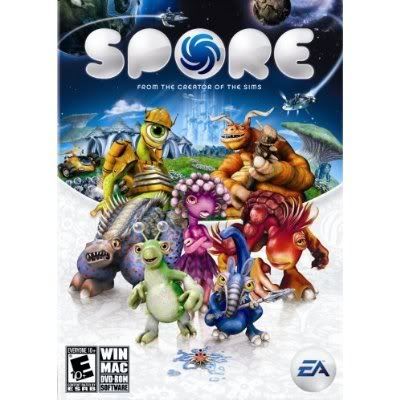
EA Justifies DRM-ing Spore
However, when it was launched a few days ago, customers had a curious reaction to its DRM copy-protection method: they trashed their review scores in high-profile sites like Amazon.
While Spore is still selling ok, it's isn't very good for a developer or distributor to have a game showing with a rating of 1 star in 5, is it?
The issue, as always, is the copy protection method: you can only install the game 3 times. After that, you'll need to contact Electronic Arts and kindly ask them for a new activation code - which they may very well refuse, after treating you as a suspect and jerking you around for a while.
This is a game you *paid for*, but you're treated like you just rented it.
The protection is well known to gamers, it's the hideous SecuROM that acts more like a virus, and can affect your computer performance and reliability.
And proving that DRM is useless, Spore was leaked on the Internet several days before its launch date, free from those pesky protections.
Why they keep using these techniques?
"That's like saying just because your house has been robbed, why do you bother putting a lock on your door?" responded Jeff Brown, EA's vice-president of corporate communications.Sure... But why do they keep putting a lock *and* a retinal scanner *and* a fingerprint reader in *our* front door, while they leave the back door open for anyone deciding not to pay for the game?
I only ask that I can play the game I paid for without worrying about my computer integrity and without being treated like a criminal.
Last game I bought for the PC was completely DRM free and it was quite successful (ET:Quake Wars) and there are many other examples.
I guess I'll just have to stay clear of EA's games...
Fortunately, some smaller developers are listening and adjusting accordingly.
via [FT]
Saturday, August 9, 2008
MPAA Wants to Contol YOU
Better than reading about it, is watching this short videoclip:
Will they ever learn?
Can't we just send the Joker have a talk with them?
Why are they always "so serious"?
Wednesday, July 30, 2008
App Store DRM Hacked - the iPhone is Free
The fairpplay DRM Appl uses in their App store has been cracked and the most popular games and apps for the iPhone are already being freely shared on the Internet.
When will they understand that the only way to end this is to make it not worth it?
Just focus on providing people what they want, without nasty DRM methods, and let people feel happy to pay for it!
How many times, haven't I bought a CD, DVD, game or whatever; *after* I had already downloaded it from the internet?
How many times haven't I downloaded stuff I already own - because I wasn't willing to keep my legally bought gam in the drive everytime I wanted to play that game?
I have no problem paying for the stuff I listen, watch, or play.
I just won't accept being trated like a criminal everytime I press play on the DVD I *bought*;
I won't accept buying a music CD that installs malware and rootkits on my PC;
I won't accept buying a computer game that installs so much crap on it just to "validate" my game.
via [Gizmodo]
Sunday, July 27, 2008
Yahoo to Shutdown DRM Music Servers
- and then, some years later -
"Ooops, we're shutting down our authentication servers - though luck!"
We've heard it from Microsoft before, but now it's the time for Yahoo to try and pull the rug under their music customer's legs.
Once those servers are gone, everyone with Yahoo music on their computers will be unable to transfer it to a new computer. So, if your computer breaks down... say goodbye to it all.
Their suggestion: "Please burn all your songs to CDs, and re-rip them to have full access to the songs."
ORLY!?!
Well, let's hope this serves a higher purpose, so that no one ever buys DRM'ed music again.
Wednesday, April 23, 2008
MSN Music Alienates Paying Customers
You can't imagine how sick I get when I read about this kind of stuff. This time is Microsoft's own MSN Music that will shutdown their DRM authentication server.What does this mean?
Well, quite simply: you'll soon be unable to transfer the music you legally bought and own to any other device.
Sure, you'll still be able to listen to it on the current computer, using the current operating system. But don't even thing of touching that machine again. Upgrading to a new OS or new computer? Forget it! That music will be forever locked in that old aging computer... until it's gone for good.
As always, they'll probably suggest you burn your music into CDs and re-rip it.
But... what's the whole point of buying downloadable digital music???
What more does it take for them to see that DRM like this simply doesn't work?
Tuesday, December 11, 2007
DRM was tried in 1923 - and failed!
[Original portuguese article here]
Well, that's exactly what's going on with DRM (Digital Rights Management) right now.
No matter how good the concept may look on paper, getting it to work without causing a major headache to consumers is a whole different matter.
You've paid for it, you'd expect to use it as you see fit.
Just not very long ago, thousands of subscribers lost all their sports games they had paid for when the company changed it's DRM scheme to a different system - they were left with nothing, unable to play those old obsolete DRM video files in their players.
The same has happened time and time again with music on portable players. Want to transfer those songs you paid for to a new portable device? You're out of luck!
In the real world, those who "pirate" stuff end up using the files as everyone should - while those who pay for it get "screwed". This doesn't make sense!
I won't even delve into wondering how they justify spending millions (billions?) in copy protection and DRM schemes - like the infamous CSS on DVDs and the AACS on newer HD discs. Schemes that are quickly bypassed by "pirates", and offer nothing good to regular consumers - quite the opposite: the added complexity drives costs up, and it's you and me who are supposed to pay for it.
Take the latest MS operating system, Vista, that devotes more time encrypting and protecting its copyrighted files from possible misuse (wasting a lot of CPU power in the process) than to make your computer work as efficiently as possible.
But let's see how things were back in 1923...
Radio gets to Austrália [1923]
(Source [BlogCampaining])
When radio broadcasts arrived to Australia, obviously they were already worried about protecting consumers from themselves - sort of an "Analog Rights Management".
So, what did they come up with? Each radio was sold tuned to a specific preset frequency. Each radio station sold it's own unique and different radio, properly sealed so that no one would dare tampering with it. (No, I'm not joking!)
Can you imagine it? Want to listen to a different radio station? Buy another radio!
Obviously, the system was deemed a complete failure in less than two years.
Today, the formats and media have changed, but they keep wanting to do just the same exact thing. You buy a song or a movie, you can only play it in a specific device, and if they ever decide you can't play it anymore - you're stuck with it.
Why is it taking so long to see this is still a failure today?
Saturday, December 8, 2007
WD external HD tells you what you can(t) to with your own Files
This is nice.You buy a brand new Western Digital 1TB external hard drive to store all your media files. You go home and trannfer all your songs and movies to the new storage device.
You head to your living room, fire up your media center and try to play a movie from your new WD disc and...
Due to unverifiable media license authentication, the most common audio and video file types cannot be shared with different users using WD Anywhere Access.From Wired:
It doesn't matter what the files are: If you try to share these formats over a network, Western Digital assumes not just that you're a criminal, but that it is its job to police users. You see, MP3, DivX, AVI, WMV and Quicktime files are copy-protected formats.The list of banned filetypes includes more than thirty extensions. Some of them are bizarre: .IT files are banned — these are Amiga-style music modules composed with Impulse Tracker, a particularly well-loved tracking sequencer that hasn't been updated in almost a decade. I composed with IT myself, back in the day, and still have all my shitty compositions, none of which Western Digital would have me share. (Try MOD vs. Speak&Spell masterpiece Eddie Dreams of Women, if you dare: IT, MP3)
via [Wired]
Friday, November 9, 2007
DRM gets another nail in the coffin
This is getting out of hand. Hopefully, customers won't take this crap anymore.Make sure you don't get ripped off!
Source [Download Squad]
Major League Baseball has deactivated a DRM license server used to verify your worthiness to play back video of games you purchased online.
Due to an earlier decision to switch DRM providers, MLB's new content and old content are managed by different license authentication servers. After making the switch, MLB has arbitrarily decided it has no intention of honoring its earlier commitments to fans who purchased downloaded games under the old system, thereby rendering many fans shut-out.
Claiming the full-game downloads were "one-time sales", MLB is completely unapologetic to fans who've lost their purchased content to the horrors of DRM death. Quoted on Boing Boing, baseball super-fan and author Alan Wood writes, "Just got off the phone with a MLB customer service supervisor. [who said] 'MLB no longer supports the DDS system' that it once used and so any CDs with downloaded games on them 'are no good. They will not work with the current system.'"
Shame on you Major League Baseball, this is fraud. We've warned Download Squad readers that buying DRM "protected" media is a crap-shoot, but when issuing those warnings we were mostly concerned about smaller media sales outlets going out-of-business in an ever evolving digital media landscape. This goes so far beyond those fears, with an active and profitable business making a clear and informed decision to yank the DRM rug out from under your purchased content.
Is it any wonder non-drm downloads via P2P are so popular? It's not simply about "free" in the base, capitalist notion of how much money changed hands, it's more pointedly about "freedom", the freedom to do what you wish with the content you've collected. If consumers aren't given options which allow them to get their content free as in freedom, they'll take that content free as in beer.